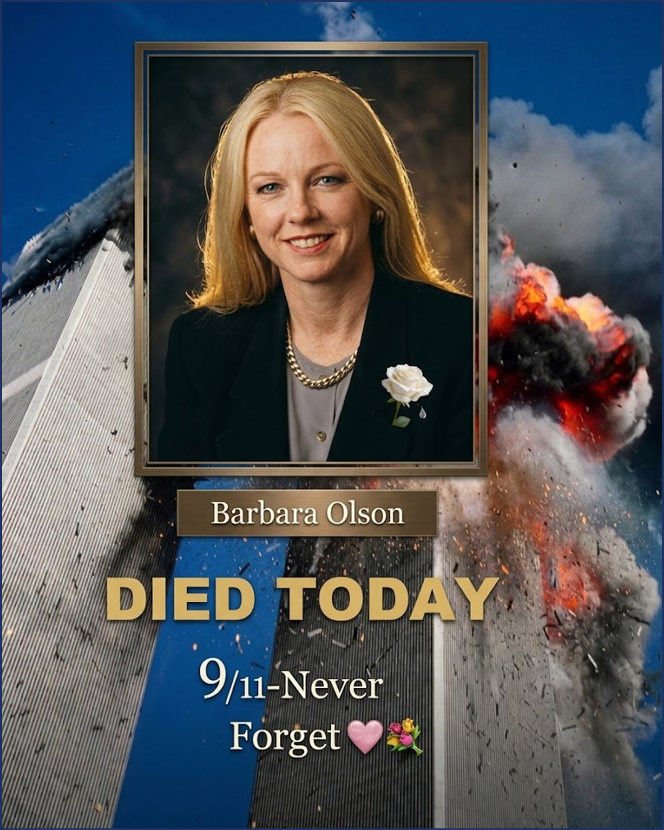
Barbara Kay Olson (December 27, 1955 – September 11, 2001) was an American lawyer, author, and prominent television political commentator whose life was tragically cut short during the terrorist attacks of September 11, 2001. Remembered for her intelligence, determination, and outspoken personality, Barbara left a lasting mark on American public life and became one of the many innocent victims whose stories are forever connected to that heartbreaking day.
1. Early life and family background
Barbara was born Barbara Kay Bracher on December 27, 1955, in Houston, Texas. She grew up in the United States and pursued an education that would eventually lead her into the fields of law, public service, writing, and political commentary. She earned her undergraduate degree from the University of Saint Thomas in Houston before studying law at the Benjamin N. Cardozo School of Law at Yeshiva University in New York.
Her education helped establish the foundation for a career built on research, communication, and legal analysis. Barbara developed a reputation as a confident and articulate professional who was comfortable discussing complicated legal and political issues before an audience. She was not simply a television personality; she was a trained lawyer who had spent years working with legal and governmental matters.
In her personal life, Barbara found love with Theodore “Ted” Olson, a respected American attorney who later served as solicitor general of the United States under President George W. Bush. They married in 1996 and shared a life shaped by their professional commitments, conversations about public affairs, and affection for one another. Their relationship would become central to one of the most heartbreaking stories associated with September 11.
Barbara built an impressive career in Washington, D.C., working in legal and political environments where important national issues were debated. She served as an assistant U.S. attorney in the District of Columbia and worked on investigations involving government affairs. Her experience gave her an understanding of the legal system and the political institutions that shaped American public life.
As her career developed, Barbara became increasingly well known through television appearances and political commentary. She appeared on major news networks, including CNN and Fox News, where she discussed legal controversies, public policy, and national politics. Her confident presentation and direct communication style made her a recognizable figure to viewers interested in American political affairs.
She was also an author who used her writing to express her views on government and political power. Her work attracted attention and made her a familiar name in political discussions. Although her opinions were sometimes controversial, her career demonstrated her commitment to participating in the national conversation.
Behind the public image was a woman whose life involved ordinary personal moments as well as professional responsibilities. She was a wife, a family member, a colleague, and a friend. Her story reminds us that the people remembered from September 11 were individuals with their own relationships, ambitions, routines, and hopes for the future.
3. September 11, 2001: The morning that changed everything
On Tuesday, September 11, 2001, Barbara’s life took a tragic turn. She was traveling aboard American Airlines Flight 77, a Boeing 757 scheduled to fly from Washington Dulles International Airport to Los Angeles, California. She was going to Los Angeles for a scheduled appearance on the television program Politically Incorrect, hosted by Bill Maher.
Barbara had originally planned to travel to California a day earlier, but she delayed her trip so she could spend the morning with her husband on his birthday, September 11. What should have been an ordinary day of travel and a birthday celebration instead became part of one of the darkest days in American history.
As the terrifying situation unfolded, Barbara managed to contact her husband, Ted Olson, who was working in Washington as the U.S. solicitor general. During their first reported conversation, she told him that the aircraft had been hijacked and described the weapons carried by the attackers. The call ended after approximately a minute.
Barbara contacted him again shortly afterward. During their second reported conversation, she explained that the pilot had announced the hijacking and asked her husband what she should tell the captain to do. Ted tried to understand where the aircraft was and what might be happening. The conversations provided officials on the ground with important information about the unfolding emergency.
These calls became one of the most deeply moving parts of Barbara’s story. A husband was trying to help his wife from miles away, while she was trapped aboard a hijacked aircraft with little control over what would happen next. Their final conversations reflected the terrible helplessness experienced by families on September 11, when love and concern could not overcome the distance between those in danger and those waiting on the ground.
At approximately 9:37 a.m. Eastern Daylight Time, American Airlines Flight 77 crashed into the Pentagon in Arlington, Virginia. Barbara Olson was killed along with the other passengers and crew members aboard the aircraft. People inside the Pentagon were also killed in the attack. Her death, at just 45 years old, ended a life filled with professional accomplishments, personal relationships, and plans for the future.
Barbara’s death was devastating for Ted Olson and the people who knew her. Her husband had spent those final moments attempting to understand the emergency and communicate with her, but he could not prevent the tragedy.
The fact that September 11 was also Ted’s birthday makes their story especially heartbreaking. A date that might otherwise have been remembered for a happy morning together became a permanent reminder of a life lost and a future that would never unfold as they had expected.
Barbara’s story also illustrates how the attacks reached far beyond the buildings struck that morning. Every victim had a family, friends, colleagues, and personal memories that could not be replaced. Behind the television coverage and historical accounts were thousands of individual losses, each carrying its own grief.
5. Barbara Olson’s legacy and remembrance
Barbara is remembered as a lawyer, author, political commentator, and victim of the September 11 attacks. Her story remains part of the historical record because of her professional career and the reported telephone conversations that connected her with her husband during the hijacking.
Her name is inscribed at the National September 11 Memorial in New York, where victims of the attacks are honored. The Smithsonian National Museum of American History also preserves the office telephone used by Ted Olson when he received calls attributed to Barbara that morning. The object serves as a reminder of how communication technology connected families during a day of unimaginable uncertainty.
September 11, 2001, remains a day of mourning for the United States and for people around the world. The memory of Barbara Olson stands among the countless stories that help future generations understand the human cost of that terrible morning.
May Barbara Olson rest in peace. 💐🕊️🇺🇸